
Clinical Spanish in 2026: Why Literal Translation Fails in a Medical Visit.
Jan 15, 2026
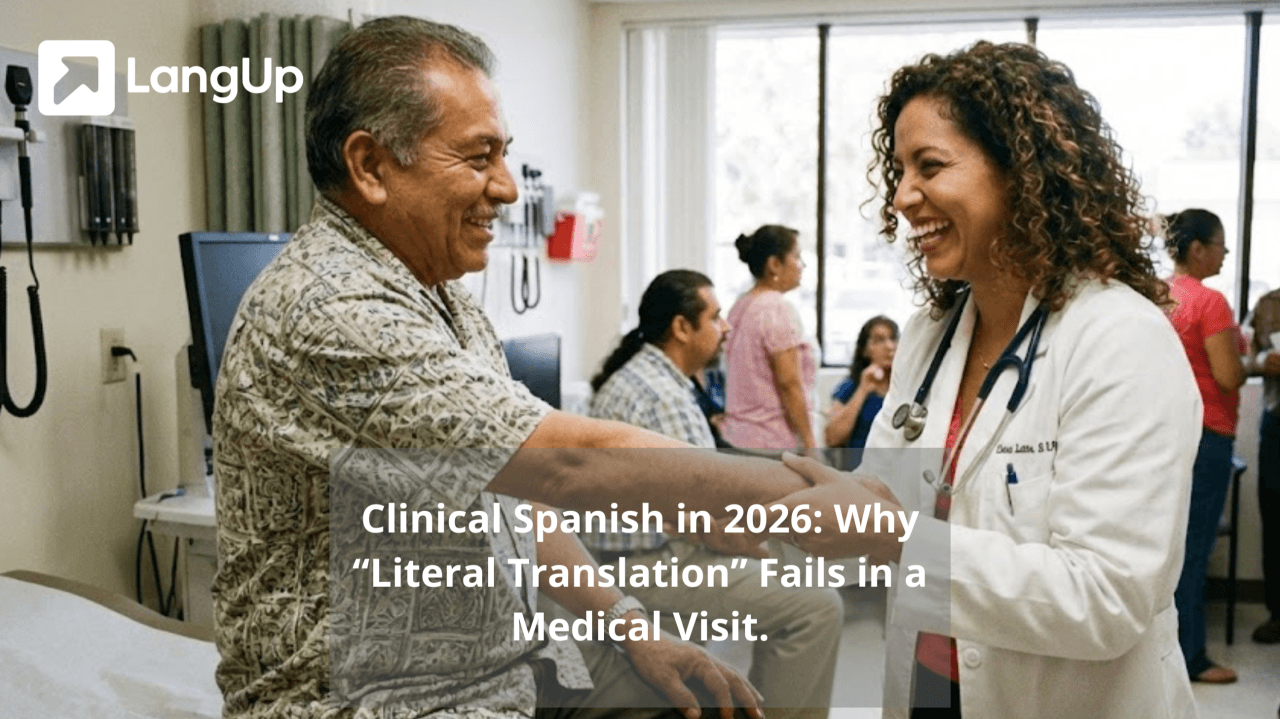
Clinical Spanish in 2026: Why “Literal Translation” Fails in a Medical Visit.
By: Santiago Cantillo
In healthcare, Spanish isn’t about “sounding fluent.” It’s about being understood—fast, clearly, and safely.
And here’s the problem: many beginners try to translate word-for-word from English… and that’s exactly how misunderstandings happen.
This guide breaks down the most common literal-translation mistakes in a medical visit—and gives you safer, simple phrases you can start using from day one.
First: a safety note
Learning Spanish helps with rapport and basic communication, but it does not replace a professional medical interpreter—especially for consent, diagnoses, risks, medication instructions, or anything high-stakes.
Think of Clinical Spanish as:
Better connection + smoother basic intake
Clearer instructions for simple steps
Less anxiety for patients
Not a substitute for certified interpretation
The rule that changes everything: “Translate the meaning, not the words”
In clinical settings, the goal is functional clarity:
Use simple Spanish
Ask one idea at a time
Confirm understanding
Avoid slang/idioms
If you remember one thing: Short + clear beats perfect.
7 common literal-translation mistakes (and safer alternatives)
1) False friends that can seriously confuse
Some words look similar but mean something else.
“I’m constipated” ❌ Estoy constipado/a (often understood as “I have a cold”) ✅ Estoy estreñido/a.
“I’m embarrassed” ❌ Estoy embarazado/a (pregnant) ✅ Me da pena. / Estoy avergonzado/a.
“Intoxicated” (poisoned vs drunk) ❌ Estoy intoxicado/a (often = poisoned) ✅ Drunk: Estoy borracho/a. ✅ Poisoned: Creo que me intoxiqué.
2) “Do you have pain?” asked too broadly
Patients may answer “yes” but you still don’t have what you need.
Instead of one big question, use a mini sequence:
¿Dónde le duele? (Where does it hurt?)
¿Desde cuándo? (Since when?)
¿Cuánto le duele del 0 al 10? (0–10 scale)
3) Using English structures that sound unnatural or unclear
English: “Are you taking any medications?” Too literal: ¿Estás tomando cualquier medicación? (awkward)
Better:
¿Toma algún medicamento?
¿Qué medicamentos toma?
4) “Allergy” confusion: alergia vs side effects
Some patients may describe a side effect as an allergy.
Use a clarifier:
¿Es alergia o le cae mal? (Allergy or it upsets you?)
¿Le da ronchas o le falta el aire? (Hives or trouble breathing?)
5) Saying “open your mouth” too bluntly (tone matters)
Spanish often uses polite commands, especially in care settings.
Instead of:
❌ Abre la boca. Use:
✅ Abra la boca, por favor. (formal)
✅ ¿Puede abrir la boca, por favor? (even softer)
6) “Dizzy” isn’t one thing
English “dizzy” can mean different sensations.
Ask:
¿Se siente mareado/a? (dizzy/lightheaded)
¿Siente que todo da vueltas? (room spinning/vertigo)
7) Idioms don’t travel well
English: “How are you feeling today?” is fine. But avoid idioms like “under the weather,” “heartburn is killing me,” etc.
Keep it literal and clear:
¿Cómo se siente hoy?
¿Qué síntomas tiene?
5 communication moves that prevent misunderstandings
One question at a time
Use “teach-back” (gold standard)
Confirm details out loud
Ask permission + be polite
Know when to call an interpreter
A beginner-safe “Clinical Spanish” phrase pack (useful on your next shift)
Intake basics
¿Cuál es su nombre y fecha de nacimiento?
¿Qué le trae hoy?
¿Tiene fiebre, tos o dolor?
Pain
¿Dónde le duele?
¿Desde cuándo?
¿Es un dolor fuerte o leve?
Meds + allergies
¿Toma algún medicamento?
¿Es alérgico/a a algún medicamento?
¿Qué pasó cuando lo tomó?
Next steps
Voy a revisar su presión/temperatura.
Necesito que respire profundo.
Un momento, por favor.
The 10-minute practice plan (busy-proof)
If you’re learning from zero and want real progress:
Daily (10 minutes):
3 min: read 5 phrases out loud (slow, clear vowels)
4 min: roleplay one intake scenario (you ask, imaginary patient answers)
3 min: teach-back practice (“Can you repeat the instructions?”)
Ultra-busy day:
2 minutes: ¿Dónde le duele? ¿Desde cuándo? ¿Cuánto del 0 al 10? (repeat x3)
Make Clinical Spanish useful, not perfect
Your goal isn’t to “speak like a native.” Your goal is to reduce confusion, build trust, and communicate safely, one clear sentence at a time.